For the bourbon drinker with empirical leanings, Buffalo Trace periodically comes out with 2 lines of quasi-experimental offerings: the Single Oak Project and the Experimental Collection. The SOP is a sprawaling project mainly focusing on (you guessed it) oak, while the BTEC is more varied. The latter is really fun for me, because many of the offerings really seem to be products of a "I wonder what would happen if we..." sort of conversation than those of a marketing discussion. The BTEC have often been odd, always sort of overpriced, and sometimes awful (BT even regrets the oat bourbon, I hear). Though these are overpriced when compared to bourbon bought simply for pleasure (~$50 per 375), they are often fun and novel.
Keeping with the recent theme of Buffalo Trace's 15% rye mashbill, we will look at three BTEC whiskies (they are not all legally bourbon) that differ most obviously by their cooperage (also age). Before we begin, it is best to review that Bourbon is legally a spirit made using at least 51% corn, distilled at less than 160 proof and entered into unused, charred, oak barrels at no more than 125 proof (among other requirements). Distillers vary on how they char the barrels; Buffalo trace typically chars theirs for 55 seconds (#4 char), but for this release they experimented with different oak aging regimens.
_____
The "Hotbox"-treated bourbon was put into barrels made using staves that were toasted before being assembled into a barrel and charred in the traditional fashion. The hope here was to improve the flavoring potential of the uncharred oak layer that absorbs and exchanges whiskey during aging.
BTEC Hotbox Toasted Barrel (16 years, 8 months old, 45%ABV)
Nose: Hot attic, orange peel, some tropical fruit (hint of bananna, maybe papaya), caramel and vanilla.
Palate: Medium-thin texture, well-controlled alcohol. Wheater-like wood influence and nuttiness. Little rye spice, but age notes of acetone, coconut, almonds, maybe a bit of ginger.
Finish: Very tame, mildly tannic, medium sweetness and length. Fruit and vanilla persist the longest.
Overall this is an excellent bourbon that reminds me of Van Winkle wheater offerings more than anything else out of Buffalo Trace. For whatever reason, this barrel seems to show a lot more wood, nuts and fruit than rye spice, chocolate or char notes. I suspect the toasting added some of the extra oak flavors that take such central prominence in older wheaters. The aging here sure didn't hurt. I really like this and would love to see it at a bit higher proof (to solve the thin mouthfeel) and at a slightly more reasonable price (though it is nearly 17 years old).
___
The #7 Char experiment differs in oak treatment from the BT standard practice by charring the inside of the oak barrels for a full 3.5 minutes instead of the usual 55 seconds. I suppose that this experiment should at least demonstrate the upper end of the influence of charring on the finished bourbon.
BTEC #7 Heavy Char Barrel (15 years, 9 months old, 45%ABV)
Nose: Apples, milk chocolate and charcoal. Also some rye spices. Overall reminds me of a more muted Blanton's
Palate: Similar in weight to the Hotbox. Overall pretty mild. Corny sweetness, apple, faint spices (clove and ginger), again milk chocolate and some butter.
Finish: Very easy, warming and sweet. Tannins appear at the very end, though not unpleasantly.
Overall this is a much more subdued experience than the Hotbox. It is nice, but not what I would have hoped for a 15 year expression of a bourbon that starts out essentially as Blanton's. I suspect that the huge amount of char may have acted to "charcoal filter" out some of the flavor. This reminds me a bit of the George Dickel Barrel Select in it's drinkability. The result is mild to be sure, but not interesting enough to call a success, or to go out of your way to find.
____
Finally, the French Oak experiment. Typically, bourbon is aged in American white oak (Quercus alba). For this experiment, #2 mashbill new make was entered into barrels made of French oak (both Quercus robur and Quercus petraea are called French oak in wine/spirit making, the latter is more likely here). In winemaking, French oak is considered to impart a fruitier, spicier and more "exotic" profile to wine, compared to the sweeter, vanilla dominated profile of American oak. Interestingly, in this experiment, the barrels were toasted only, thus making this whiskey not technically a bourbon as it has never seen the inside of a charred barrel.
BTEC 1995 French Oak Barrel Aged (15 years, 3 months old, 45%ABV)
Nose: First impression is rum-finished Scotch. Incense, floral perfume notes, overripe mango, white chocolate and a scented-candle note I can't quite place.
Palate: Medium bodies, drier and more astringent than the above. Very wine-like and a bit bitter. Wood tannins are evident, but little of the typical vanilla/caramel/butter seen with charred oak. A funky note that reminds me of single malt or pot-still Irish.
Finish: Astringently tannic and a bit bitter. Some spice/incense lingers, as does a fruity sourness.
Overall this is an odd one. I would never have picked this as an American whiskey. I would have guessed either a Balvenie* I've not yet tried (the winey, funky notes are reminiscent), or maybe a wine-finished Scotch. It is very a very interesting illustration of the effects of oak and a very unusual drink; just not one I find pleasant, unfortunately. I have to applaud the willingness to experiment and the dedication to empiricism, but I have to categorize this as an informative failure.
____
I have to say I think these experiments of Buffalo Trace's are really pretty cool. We get to see the effect of so many of the different contributors to a finished whiskey. As I've said before, I think we all get too hung up on mashbill, when so many other variables come into play, in this case cooperage. Proof also seems to be a major factor in how enjoyable and intense a bourbon is, but really just changes intensity, rather than character. Warehouse location seems really under-appreciated when you see how different the AAA tastes compared to Blanton's. Entry proof is another big one, but that will be another post.
So are any of these worth buying a full bottle of? Not really at these prices. I split these half bottles with a friend, so it was worth it to me for curiosity and novelty, but I'm not sure I'd drop $100 a fifth on any of them But if BT were to produce larger quantities of any of these at a lower price, I'd definitely go with the Hotbox. And not just for the name.
I'm off on a brief hiatus for a road trip; along the way I hope to find some interesting things to share. I will also turn my attention soon to the excellent Four Roses distillery, that I have so far neglected for no good reason.
* Despite the reminiscence, I will clarify that I like Balvenie, before you start to object!
Showing posts with label Bourbon. Show all posts
Friday, August 30, 2013
Saturday, August 24, 2013
Bonus Buffalo Trace Mashbill #2 Review: Ancient Ancient Age 10 Year
| Ancient Ancient Age? Really? |
I can't really confirm the recent rumors of AAA 10 year's hiatus/discontinuation, but in today's market I'm sure that BT/Age have more lucrative plans for this juice than a $20/L treat for Kentuckians. Either way, I'm glad to have found this.
Ancient Ancient Age 10 year-old KSBW (43%ABV, $33/ 1.75L) Distilled by Buffalo Trace
Nose: Butter/buttered corn (diacetyl?), apple pie, caramel apple, and a small amount of baking spices
Palate: Easy, moderately sweet with thin mouthfeel. Definite apples here, as well as vanilla.
Finish: Brief but with finally evident rye spice
I was very happy to have found this and, having tried it, I totally understand the cult following. Interestingly, I don't find it to be very like Blanton's: this is thinner (obviously from the proof) but also more buttery and less rye-forward. There is also less barrel influence overall, despite the 10 year age statement. I suspect the less prominent barrel character is to do with warehouse location (a lower floor or different warehouse perhaps?). Overall, though a very nice and classic bourbon.
I was initially going to run back and buy the rest of the store's stock, but I think I will leave it for others: this is more a reminder of how good and cheap bourbon was just a few years ago than something worth hoarding. Though it is definitely worth drinking if you are of the type that likes a standard/go-to/house bourbon. For me, I am always going to want more variety, and a handle of this is enough for now. That said, I don't think we'll see it's like again for this price, at least not for a long time.
Outstanding value and very good/excellent regardless of price
Wednesday, August 21, 2013
Buffalo Trace Mashbill #2 Part One: Blantons Original Single Barrel, Gold and "Straight from the Barrel"
Then did he raise on high the Holy Hand Grenade of Antioch, saying, "Bless this, O Lord, that with it thou mayst blow thine enemies to tiny bits, in thy mercy." And the people did rejoice and did feast upon the lambs and toads and tree-sloths and fruit-bats and orangutans and breakfast cereals ...
Blanton's has always pleasantly reminded me of the Holy Hand Grenade of Antioch (known to the observant as the globus cruciger), but unlike the symbol I first remember seeing in terribly boring and neurosis-inducing CCD classes, I've nothing but fond memories of Blanton's. As the first successful single-barrel bourbon, Blanton's was the late Elmer T. Lee's gift to the bourbon world and the beginning of bourbon's rise to its current place of recognition as an equal among world-class whiskies.
The unfortunate, recent passing of Mr. Lee (more thoughtfully eulogized in many recent articles by those who knew him than I could do justice to by adding my own) has put us all in mind of his efforts and legacy in the bourbon world. I have been excited by the prospect of the next two posts for some time now, as I have in any case long been a fan of bourbons made with the "#2 rye bourbon mashbill" of Buffalo Trace. This mashbill is often referred to as BT's "high-rye mashbill", but at ~15% rye this is really about the average for traditional bourbon, though higher than the ~8% mashbill used for the "#1" mashbill used for the Stagg, Eagle Rare, and Buffalo Trace label bourbons, which is one of the lowest in the industry.
As a point of trivia, the #2 MB Brands (Ancient Age, Blanton's, Eltmer T. Lee, Hancock's and Rock Hill Farms), while distilled at BT, are actually owned by the Takara Shuzo Lrd Co, who acquired Age International a few years back. This is why the Japanese get more Blanton's variety than we do. I wonder if this is also why my prayers for a #2 MB in the Antique Collection have gone unanswered for so long...
Last weekend, my friend Greg and I sat down to try to get a handle on the 3 major expressions* of Blanton's: The Original Single Barrel, the Gold Edition, and "Straight from the Barrel." Only the Original is available in the United States; Greg's SFTB came from Master of Malt, and I traded for the Gold (thanks again u/dementedavenger99). All 3 of these are single barrel bourbons from the same mashbill, aged in Warehouse H, distilled to 140 proof, and entered into barrels at 125 proof. While there have been speculations about different ages and barrel selection profiles, the clearest differences between them are the bottling proof: Original is bottled at 93 proof, Gold at 103 and SFTB at cask strength. On to the tasting (note these are all single barrel bourbons, so variability is to be expected):
Blanton's Original Single Barrel Bourbon (Barrel # 184, dumped 7-4-13, 46.5% ABV)
Nose: Apples, pears, sawn wood, vanilla bean, ethanol
Palate: mid-heavy weight, quite smooth, more intense than average, sweet with fruit, vanilla, mild spiciness and well-balanced oak. No yeasty or off flavors. Classic bourbon profile, but more intense and heavier bodied than is usual.
Finish: Relatively short and overall echoes the palate with no real bitterness or harshness. Leaves the mouth cool.
Overall, this is a very classic and very well made bourbon. I would almost go so far to say that if you don't like this, you don't like bourbon, as this is basically archetypal, if maybe a little sweet. My only gripe is that $50 is a little high for ~8 year old bourbon made in this quantity, even with the inclusion of the nice stopper and the velvet bottle scrotum (bag? cozy?).
Blanton's Gold Edition Bourbon (Barrel #239, dumped 3-1-12, 51.5% ABV)
Nose: Similar to the Original but more intense and more butter/caramel and ether notes. Also perhaps less wood. More interesting
Palate: Heavier and more intense with more evident alcohol burn. More tannic and textured as well. Honey and oak, perhaps less fruit.
Finish: Compared to the Original, more warming and persistent with lingering fruit and spice.
Overall this is a small but clear step up from the Original, it is basically Blanton's but modestly better in every way. It is hard to imagine liking Blanton's Original and not liking this a little bit better. I think that this is almost 100% due to bottle proof, as watering it down to the 93 of the Original yields a bourbon that while not identical (perhaps due to barrel variation) seems much more parallel.
Blanton's Straight from the Barrel Bourbon (Barrel 270, dumped 3-7-12, 66.25% ABV)
Nose: More alcoholic, a bit burning to the nostrils. With air ether/acetone notes join the alcohol as well as some rye spiciness, followed by wet oak. Much less fruit here.
Palate: Hot, numbing. Still sweet like the others, with prominent vanilla and butter. Some molases as well as cookie spices.
Finish: A bit numbing due to high ABV, but very long and overall pleasant and echoing the palate.
Overall, this seems less complex and more alcohol dominated in a way that makes me think that it may actually be younger than the other two. Watering it to 103 does not yield gold (with again the caveat that barrels vary); the result is much more thinner, a bit lighter in color, less sweet and less complex. I like it less than the Original, even at 103 proof. As it is not 100% pleasant to drink at barrel strength, and less pleasant diluted than the others, I'm afraid to say this may be my least favorite of the three.
In summary, this was a very enjoyable survey of some of the more elusive Blanton's expressions, and here is my final take:
Blanton's Original is excellent bourbon, full stop. It is, however, a bit overpriced consigning it to the category of bourbon to buy when you have no access to limited releases and want to throw money at the problem. A fine gift and a nice occasion bourbon. I would buy loads of it for $30. As is, I would happily get rid of all of it for more access to Gold in the US.
Blanton's Gold is much more clearly a premium product, and one that provides an "A-Ha" moment when first sipping. This is the version that I think should be the one we get, if we get only one, and would be worth the $50 the original now commands. If they were to present us with this, there may not be so many bottles of Blanton's in every liquor store I've ever been to. As it stands, I think this is actually worth seeking out for fans of the Original.
Blanton's SFTB is a bit of a disappointment. Maybe it was the barrel I got but I was excited for this to be the most intense and enjoyable of the three, but it was just more alcoholic. The disappointment came from the sense that it had more alcohol without a proportional increase in flavor, which was seen when watering it down. Whether or not my suspicion is true, this tastes younger to me and in any case I prefer the Original, so there is really no reason to buy this.
Next, we will examine whether a $33 plastic 1.75L of Ancient Ancient Age can stand up to any of these, and then we will look at 3 iterations of the Buffalo Trace Experimental Collection that all treat this mashbill in very different ways.
Blanton's has always pleasantly reminded me of the Holy Hand Grenade of Antioch (known to the observant as the globus cruciger), but unlike the symbol I first remember seeing in terribly boring and neurosis-inducing CCD classes, I've nothing but fond memories of Blanton's. As the first successful single-barrel bourbon, Blanton's was the late Elmer T. Lee's gift to the bourbon world and the beginning of bourbon's rise to its current place of recognition as an equal among world-class whiskies.
The unfortunate, recent passing of Mr. Lee (more thoughtfully eulogized in many recent articles by those who knew him than I could do justice to by adding my own) has put us all in mind of his efforts and legacy in the bourbon world. I have been excited by the prospect of the next two posts for some time now, as I have in any case long been a fan of bourbons made with the "#2 rye bourbon mashbill" of Buffalo Trace. This mashbill is often referred to as BT's "high-rye mashbill", but at ~15% rye this is really about the average for traditional bourbon, though higher than the ~8% mashbill used for the "#1" mashbill used for the Stagg, Eagle Rare, and Buffalo Trace label bourbons, which is one of the lowest in the industry.
As a point of trivia, the #2 MB Brands (Ancient Age, Blanton's, Eltmer T. Lee, Hancock's and Rock Hill Farms), while distilled at BT, are actually owned by the Takara Shuzo Lrd Co, who acquired Age International a few years back. This is why the Japanese get more Blanton's variety than we do. I wonder if this is also why my prayers for a #2 MB in the Antique Collection have gone unanswered for so long...
Last weekend, my friend Greg and I sat down to try to get a handle on the 3 major expressions* of Blanton's: The Original Single Barrel, the Gold Edition, and "Straight from the Barrel." Only the Original is available in the United States; Greg's SFTB came from Master of Malt, and I traded for the Gold (thanks again u/dementedavenger99). All 3 of these are single barrel bourbons from the same mashbill, aged in Warehouse H, distilled to 140 proof, and entered into barrels at 125 proof. While there have been speculations about different ages and barrel selection profiles, the clearest differences between them are the bottling proof: Original is bottled at 93 proof, Gold at 103 and SFTB at cask strength. On to the tasting (note these are all single barrel bourbons, so variability is to be expected):
Blanton's Original Single Barrel Bourbon (Barrel # 184, dumped 7-4-13, 46.5% ABV)
Nose: Apples, pears, sawn wood, vanilla bean, ethanol
Palate: mid-heavy weight, quite smooth, more intense than average, sweet with fruit, vanilla, mild spiciness and well-balanced oak. No yeasty or off flavors. Classic bourbon profile, but more intense and heavier bodied than is usual.
Finish: Relatively short and overall echoes the palate with no real bitterness or harshness. Leaves the mouth cool.
Overall, this is a very classic and very well made bourbon. I would almost go so far to say that if you don't like this, you don't like bourbon, as this is basically archetypal, if maybe a little sweet. My only gripe is that $50 is a little high for ~8 year old bourbon made in this quantity, even with the inclusion of the nice stopper and the velvet bottle scrotum (bag? cozy?).
Blanton's Gold Edition Bourbon (Barrel #239, dumped 3-1-12, 51.5% ABV)
Nose: Similar to the Original but more intense and more butter/caramel and ether notes. Also perhaps less wood. More interesting
Palate: Heavier and more intense with more evident alcohol burn. More tannic and textured as well. Honey and oak, perhaps less fruit.
Finish: Compared to the Original, more warming and persistent with lingering fruit and spice.
Overall this is a small but clear step up from the Original, it is basically Blanton's but modestly better in every way. It is hard to imagine liking Blanton's Original and not liking this a little bit better. I think that this is almost 100% due to bottle proof, as watering it down to the 93 of the Original yields a bourbon that while not identical (perhaps due to barrel variation) seems much more parallel.
Blanton's Straight from the Barrel Bourbon (Barrel 270, dumped 3-7-12, 66.25% ABV)
Nose: More alcoholic, a bit burning to the nostrils. With air ether/acetone notes join the alcohol as well as some rye spiciness, followed by wet oak. Much less fruit here.
Palate: Hot, numbing. Still sweet like the others, with prominent vanilla and butter. Some molases as well as cookie spices.
Finish: A bit numbing due to high ABV, but very long and overall pleasant and echoing the palate.
Overall, this seems less complex and more alcohol dominated in a way that makes me think that it may actually be younger than the other two. Watering it to 103 does not yield gold (with again the caveat that barrels vary); the result is much more thinner, a bit lighter in color, less sweet and less complex. I like it less than the Original, even at 103 proof. As it is not 100% pleasant to drink at barrel strength, and less pleasant diluted than the others, I'm afraid to say this may be my least favorite of the three.
In summary, this was a very enjoyable survey of some of the more elusive Blanton's expressions, and here is my final take:
Blanton's Original is excellent bourbon, full stop. It is, however, a bit overpriced consigning it to the category of bourbon to buy when you have no access to limited releases and want to throw money at the problem. A fine gift and a nice occasion bourbon. I would buy loads of it for $30. As is, I would happily get rid of all of it for more access to Gold in the US.
Blanton's Gold is much more clearly a premium product, and one that provides an "A-Ha" moment when first sipping. This is the version that I think should be the one we get, if we get only one, and would be worth the $50 the original now commands. If they were to present us with this, there may not be so many bottles of Blanton's in every liquor store I've ever been to. As it stands, I think this is actually worth seeking out for fans of the Original.
Blanton's SFTB is a bit of a disappointment. Maybe it was the barrel I got but I was excited for this to be the most intense and enjoyable of the three, but it was just more alcoholic. The disappointment came from the sense that it had more alcohol without a proportional increase in flavor, which was seen when watering it down. Whether or not my suspicion is true, this tastes younger to me and in any case I prefer the Original, so there is really no reason to buy this.
Next, we will examine whether a $33 plastic 1.75L of Ancient Ancient Age can stand up to any of these, and then we will look at 3 iterations of the Buffalo Trace Experimental Collection that all treat this mashbill in very different ways.
*There is also an 80 proof version that I assume mainly exists for markets who tax proof excessively. By all accounts (as if the 80 proof weren't enough) this is not worth trying to smuggle/import. There have also been silver and black labels for duty free editions.
Friday, August 9, 2013
Eagle Rare 10 and Eagle Rare 17 Reviews
Hi all. Sorry for the lapse in posting, this fatherhood thing is a bit demanding, but I think I am getting the hang of it (mostly thanks to my very dedicated wife) and so am back and will try to crank out an article on a weekly basis if I can.
This post was inspired by having bought the best bottle of Eagle Rare 10 year-old (ER10) that I have ever tried. As a widely-distributed single-barrel bottling, this one varies quite a bit, and while I have always liked it as a very well-priced representation of the Buffalo Trace mashbill #1 (low rye, also seen in Old Charter, Buffalo Trace, George T Stagg), it has sometimes erred on the soft and sweet side for me. This has been in contrast to the Eagle Rare 17 year-old (ER17) that I have long felt to be an underrated member of the Buffalo Trace Antique Collection (BTAC).
I used to think that ER17 was sort of useless; if Stagg is about the same age, same mashbill but barrel-proof, why would I buy the same thing at 90 proof for the same price? Well, the recent releases of ER17 have actually been closer to 19 years, I hear, and I think barrel selection also plays a role. Finally, there is something that seems to happen with a few months of airtime to the 17 that I just love: it maintains the sweet and soft ER profile (in contrast to the spicier Stagg profile) but gains the "age" notes that I have often admired in extra-aged bourbons and ryes that is not evident when you first pull the cork. So:
Eagle Rare 10 year-old KSBW (distilled by Buffalo Trace, $26, 45%ABV)
Nose: Lots of fruit, mostly apples and some pears, then honey and a trace of anise. Less of the usual caramel and vanilla, though these are also still here.
Palate: Heavier than I remember with lots of oak and tannins. Still sweet, but with texture from the tannins. Chocolate, caramel, fruit and hints of grass and sap.
Finish: Drying, warming and rather long; faintest bitterness, but overall very nice.
Overall:
This is a fantastic bottle of bourbon and better than any other ER10 I've had. I went back and bought the 2 remaining bottles that seemed to be from the same barrel. Though this one stands out above other bottles of ER10 I've had with its extra fruit and wood (really hits the sweet spot of youth and aging), I overall have to say that I think ER is underappreciated. Near me this is usually only a couple dollars more than standard Buffalo Trace, and I think it brings extra refinement and depth of flavor from aging that make it a pretty exceptional value.
90/100
Eagle Rare 17 year-old KSBW (Spring 2012 bottling, $59, 45%ABV)
Nose: Much woodier: polished furniture and bookstore, also pretty intense vanilla, ether/acetone, candle wax and a hint of buttered corn.
Palate: Drier and yet woodier, though not to the point of being overoaked. Coconut here, along with some almond, toasted bread, custard and cherry.
Finish: Very long, with vanilla and cherry flavors predominating, along with wood notes. No bitterness here, really pleasant.
Overall: This is clearly a close relation to the 10 year-old, and when first opened, I think it tastes pretty similar. On my second bottle of this now and I think it consistently improves with a few weeks to a month of airtime, when it develops much more pronounced "secondary" flavors of coconut and almond and the ethereal notes that I like so well come out. This is also nothing like Stagg (even Stagg diluted to 90 proof), despite the mashbill similarity, which goes again to show how much warehouse placement and barrel selection must come into play.
93/100
These bourbons illustrate how my palate has changed over the last few years: when faced with my yearly BTAC wish list it used to be Stagg>William Larue Weller>Sazerac 18>Thomas H. Handy>ER17. This is probably close to the internet consensus, and I hope it stays that way, because I'm going after a different list this year. I think my whiskey tastes are following my wine palate: I started out loving 15% ABV highly rated fruit bombs, but have settled into enjoying balance and nuance more. I no longer find most barrel-proof monsters all that pleasant (though I will probably buy a Stagg Junior and regret it).
Given this, for October, I have now settled on: Sazerac 18 (I'm going to buy as much as I can reasonably afford this year as perhaps my last chance to really stock up on aged rye), followed by ER17 (such is my newfound love for it) and maybe one Stagg, because it is fun and one of the few barrel-roof releases that retains complexity and balance. No WLW (I like it no where close to as much as Pappy, and about the same as the $25 Weller 12), and no Handy (It's fun, but it's really just barrel-proof Sazerac 6, as I either mix or dilute Handy to drinking strength, the $30 Baby Saz it s much better deal).
Anyway, October is still a long way away... Will try to be back next week.
This post was inspired by having bought the best bottle of Eagle Rare 10 year-old (ER10) that I have ever tried. As a widely-distributed single-barrel bottling, this one varies quite a bit, and while I have always liked it as a very well-priced representation of the Buffalo Trace mashbill #1 (low rye, also seen in Old Charter, Buffalo Trace, George T Stagg), it has sometimes erred on the soft and sweet side for me. This has been in contrast to the Eagle Rare 17 year-old (ER17) that I have long felt to be an underrated member of the Buffalo Trace Antique Collection (BTAC).
I used to think that ER17 was sort of useless; if Stagg is about the same age, same mashbill but barrel-proof, why would I buy the same thing at 90 proof for the same price? Well, the recent releases of ER17 have actually been closer to 19 years, I hear, and I think barrel selection also plays a role. Finally, there is something that seems to happen with a few months of airtime to the 17 that I just love: it maintains the sweet and soft ER profile (in contrast to the spicier Stagg profile) but gains the "age" notes that I have often admired in extra-aged bourbons and ryes that is not evident when you first pull the cork. So:
Eagle Rare 10 year-old KSBW (distilled by Buffalo Trace, $26, 45%ABV)
Nose: Lots of fruit, mostly apples and some pears, then honey and a trace of anise. Less of the usual caramel and vanilla, though these are also still here.
Palate: Heavier than I remember with lots of oak and tannins. Still sweet, but with texture from the tannins. Chocolate, caramel, fruit and hints of grass and sap.
Finish: Drying, warming and rather long; faintest bitterness, but overall very nice.
Overall:
This is a fantastic bottle of bourbon and better than any other ER10 I've had. I went back and bought the 2 remaining bottles that seemed to be from the same barrel. Though this one stands out above other bottles of ER10 I've had with its extra fruit and wood (really hits the sweet spot of youth and aging), I overall have to say that I think ER is underappreciated. Near me this is usually only a couple dollars more than standard Buffalo Trace, and I think it brings extra refinement and depth of flavor from aging that make it a pretty exceptional value.
90/100
Eagle Rare 17 year-old KSBW (Spring 2012 bottling, $59, 45%ABV)
Nose: Much woodier: polished furniture and bookstore, also pretty intense vanilla, ether/acetone, candle wax and a hint of buttered corn.
Palate: Drier and yet woodier, though not to the point of being overoaked. Coconut here, along with some almond, toasted bread, custard and cherry.
Finish: Very long, with vanilla and cherry flavors predominating, along with wood notes. No bitterness here, really pleasant.
Overall: This is clearly a close relation to the 10 year-old, and when first opened, I think it tastes pretty similar. On my second bottle of this now and I think it consistently improves with a few weeks to a month of airtime, when it develops much more pronounced "secondary" flavors of coconut and almond and the ethereal notes that I like so well come out. This is also nothing like Stagg (even Stagg diluted to 90 proof), despite the mashbill similarity, which goes again to show how much warehouse placement and barrel selection must come into play.
93/100
These bourbons illustrate how my palate has changed over the last few years: when faced with my yearly BTAC wish list it used to be Stagg>William Larue Weller>Sazerac 18>Thomas H. Handy>ER17. This is probably close to the internet consensus, and I hope it stays that way, because I'm going after a different list this year. I think my whiskey tastes are following my wine palate: I started out loving 15% ABV highly rated fruit bombs, but have settled into enjoying balance and nuance more. I no longer find most barrel-proof monsters all that pleasant (though I will probably buy a Stagg Junior and regret it).
Given this, for October, I have now settled on: Sazerac 18 (I'm going to buy as much as I can reasonably afford this year as perhaps my last chance to really stock up on aged rye), followed by ER17 (such is my newfound love for it) and maybe one Stagg, because it is fun and one of the few barrel-roof releases that retains complexity and balance. No WLW (I like it no where close to as much as Pappy, and about the same as the $25 Weller 12), and no Handy (It's fun, but it's really just barrel-proof Sazerac 6, as I either mix or dilute Handy to drinking strength, the $30 Baby Saz it s much better deal).
Anyway, October is still a long way away... Will try to be back next week.
Tuesday, April 30, 2013
Elijah Craig 12 versus 18: The Effects of Aging
Next up in our series is this comparison of Elijah Craig 12 year and Elijah Craig Single Barrel 18 year. The most obvious and most dramatic difference between these two is their age. The 18 is from a single barrel and is 2% lower in ABV, but otherwise these guys start off as the same 75/15/10 distillate
When bourbon is aged in its required charred oak barrels, a
number of things happen: flavors are extracted from the wood, very slow
chemical reactions take place, and evaporation occurs. All three are important,
which is why just putting the stuff in a small barrel (as many start-ups do) or
mixing it with wood chips does not result in good whiskey as oak flavors are extracted,
but little else occurs. (Thanks to my fellow reddit users, especially the
flavor chemist, “Flavorless” for expanding this. I have also heavily relied on
the text and references from the excellent blog Whisky Science)
Charred Oak Extracts
All bourbon and straight rye whiskies are aged in new,
charred oak barrels. Charring is a process where flame is applied to the inside
of a barrel to form a layer of charcoal. This can be done for varying lengths
of time, resulting in the different “char levels” used by different
distilleries. Burning the oak in this way produces reactions that form free
sugars that react with proteins. Well these sugars burn (caramelization), they form
a lot of the aromas that we associated with caramel, bread, burnt sugar, beer,
coffee etc. This burning process has made a lot of new chemical species that
are released through smoke, but after the charring is done some compounds
remain in the charred wood.
Some of the compounds related to flavor are as follows:
Hemicellulose is broken down by heat of charring and time to
furfural (nutty aromas), hydroxymethylfurfural (musty, waxy, caramel aromas),
maltol (malty aromas) and cyclotene (maple, caramel, licorice).
Lignins are polymers (long and chain-like molecules) that in the case of
oak lignins, have different sugars and aldehydes attached to them. These
compounds break down during charring or toasting, but also over time in the
native wood to provide a number of characteristic aromas like smoke, spice or
floral notes. Most notably, though, are the vanillins, which lend the
characteristic vanilla flavor to bourbon.
Lactones occur in a number of conformations and impart coconut-vanilla
aromas or a more incense-like aroma; I love the latter when I come across it.
In addition to imparting beneficial flavors to the spirit, the char layer also serves to reduce unpleasant and immature ones. Simplistically, charcoal tends to bind and draw some off flavors out of the whiskey (like your Brita filter), while others are extracted into it.
Native Wood Extracts/Reactions
Beneath the char layer of the barrel, native, uncharred wood
remains. As you might predict, this contributes flavors and aromas that one
would expect from dry wood, specifically oak. The compounds in this layer contribute to the "oakiness" of the whiskey over time. Oak from different areas and of
different species may contribute different flavors. In wine this is why American oak (much more
vanilla flavor) is very different than French oak (spicy as well as dill-like flavors).
For the whiskey to extract compounds from the native wood, the liquor needs to
first pass through the char layer. It is a slow process for the spirit to
diffuse through the char layer, and again a slow one for it to extract native
wood flavor compounds.
Most of these compounds are actually bound to polymers (such
as the lignins above) that do not readily extract into the spirit, and so must
be liberated by hydrolysis reactions that “clip” them off the chains of larger
molecules to which they were bound. Once freed, these compounds can be
incorporated into the spirit, which must then diffuse back through the char
layer (which may filer out other compounds, see below).
As the spirit slumbers away in the wood, seasonal variations
in temperature cause the barrel expand and contract and spirit is drawn in and
out of the wood, allowing passage of the spirit through the char layer as
discussed above. The rate at which this occurs is dependent on a number of
factors, including the humidity and temperature of the warehouse as well as the
temperature shifts that occur; the more dramatic the temperature changes are,
the greater the transit of the spirit in and out of the wood will be. The
tightness of the oak grain and the species of oak can also affect this (though
American whiskey uses almost exclusively the Quercus alba species).
Other Reactions
In addition to extraction of the charred oak flavors there
are other, slower reactions that take place in the barrel. Notably are those
involving tannins; familiar to anyone who drinks red wine. These compounds lend
mouth-drying astringency to red wine and this effect can also be found in
whiskey. Tannins are also involved in a number of chemical reactions that break
down unpleasant flavors in the spirit and oxidize alcohols to the ethereal top
notes so valued in extra-aged bourbons (the acetone or ether-like aromas in
Pappy or Stagg, for example). Tannins also serve to stabilize color.
The important thing about all of these factors is that they
take time. The extracted flavors (lactones, vanillins and others) actually come
out of the wood relatively quickly (likely by the time a standard 4 year-old
bourbon is dumped), but the breakdown of polymers and the reactions with
tannins are not very fast at warehouse temperatures and are actually slowed
down by alcohol, so it is not unreasonable to expect years or even decades
worth of continued flavor evolution from a barrel of spirit, accounting for the
increasing complexity of extra-aged whiskies.
Evaporation
In addition to imparting wood flavors, the barrel also serves as a semi-permeable membrane that allows passage of water and alcohol but little else. As such, part of the contents leave the barrel as the "angel's share" each year; about 8% the first year and about 3% per year thereafter. If this occurs in hot, dry environments (high warehouse floors), more water is lost, leading to higher proof spirits (like Stagg); lower floors and higher humidity lead to more alcohol loss (e.g. barrel-strength Four Roses at near 100 proof). Either way, the flavors are concentrated. This typically leads to a more intense spirit, and also one that is significantly more expensive (by our math an 18 year-old barrel will have lost 60% of its original volume)!
So, there really seem to be two phases of barrel maturation: an initial,
extractive one and a longer maturation phase. Most young bourbons on the market
are basically bottled after the extractive phase (they have pulled out a lot of
oak flavors and have had new-make flavors tamed by the charring). However, the
truly special whiskeys make it through many years of concentration and chemical
reactions that lead to much more complex complements if volatile chemicals and
thus more complex aromas and flavors. That said, it is actually an art to
produce such whiskies, as there is a reasonably high risk that too much time in
a barrel can lead to whisky that is just too "woody."
Anyway, on to the reviews at hand:
Elijah Craig 12 year-old KSBW 47%ABV ($24)
Nose: Lots of caramel and honey, some corn and vanilla, no overt oak.
Palate: Very smooth, medium sweetness, some popcorn, lots of caramel, touch of oakiness
Finish: Simple: predominantly again vanilla and caramel, but clean and nicely warming.
Overall: 90/100
Elijah Craig 18 year-old Single Barrel KSBW 45%ABV ($43) Guest note by Greg
Nose: volatile, acetone, vanilla, nutty
Palate: possibly the weakest part, slight astringency and a little alcohol poking through, nice buttery and vanilla notes (I like the tannins here, however)
Finish:
long but subtle finish, the flavors and tannins coat the mouth and are
slowly released over time or after a drink of water, very nice. (Bottle was from Barrel #3893)
Overall: 92/100
Both of these bourbons were far and away better than their Evan Williams cousins. The 12 year just exceeds the EWSB in every way and is the same price, higher proof and is easier to find. Everyone should go buy one of these that has not tried it and should give it serious consideration for official bourbon of the summer: it is great neat, actually handles rocks well and is cheap enough to share with your friends that want to put coke in it.
The 18 year was for many years the most affordable extra-aged bourbon and is now universally missed. It has become, in Greg's words, the girl from high school that you never really noticed until she was gone. I will pull a hipster and assert that I liked it before it was cool: I thought it stood up well to Pappy and was criticized for this. But even I took for granted that I could pretty much wait for the periodic sales when it would dip below $40 and not give it too much of a second thought. Now it is off the market in favor of the $130, 20 year version. God I wish I had bunkered a case of this stuff. That said, your experience may vary a bit as with all single barrel products, but definitely buy this if you can find it. If you do not enjoy it I will happily dispose of any unused portion.
Overall, I think these are two excellent examples of the best features of Heaven Hill: very well-made, very well priced, and very classically styled bourbons. These may not be the absolute pinnacle of bourbondom, but I'm pretty sure that if you don't like these, you don't like bourbon.
Greg's Thoughts
Elijah Craig 18 year is not a current product. This makes me sad. I had only had it two times before it got the axe - presumably to make way for the MUCH more expensive 20 year version on shelves now - and was underwhelmed the first time, and modestly impressed the second. The second experience motivated me to grab 3 bottles when I heard it was being retired, and that is what makes me sad. I should have gotten more. A lot more. The EC 18 is somewhat similar to the Eagle Rare 17, and that is a great thing. While the 2011 and 2012 ER 17 needed a few months of air to transform into something wonderful, this bottle has been great from the first pour. It has those wonderfully interesting tannins that you only get from a long time in barrel and I love it. I am not as good with flavor descriptions as Ryan, so I will sum up my review thusly: my Evan Williams vintage 2000 has been open for over a year and is 40% full, the EC 12 open for a year and is 25% full, the EC 18 was opened 2 weeks ago and probably won't make it to a month old. The only caveat is that the EC 18 is a single barrel product and I have read reviews of variable quality. That being said, if I can find any lightly dusty bottles still on the shelf for sub $50, I will not hesitate to purchase more.
Next: Elijah Craig Barrel Proof, PHC 2012 and Chill-Filtration
Wednesday, April 24, 2013
Heaven Hill and the Variables of Bourbon
I have been thinking for a while about the different influences that lead to the profiles of our favorite bourbons. Almost everyone goes on about mashbill (the complement of grains), but while this is very important to the final flavor, there are a number of other important factors.
Wanting to explore this further, wanting to talk about something more interesting than a straight review, and really wanting to drink some of these, my friend Greg and I dipped into our hoards for a very diverse set of bourbons that (with one exception) start off as the exact same whiskey and end up very different. It is also time for Greg's long overdue entry into writing about whiskey.
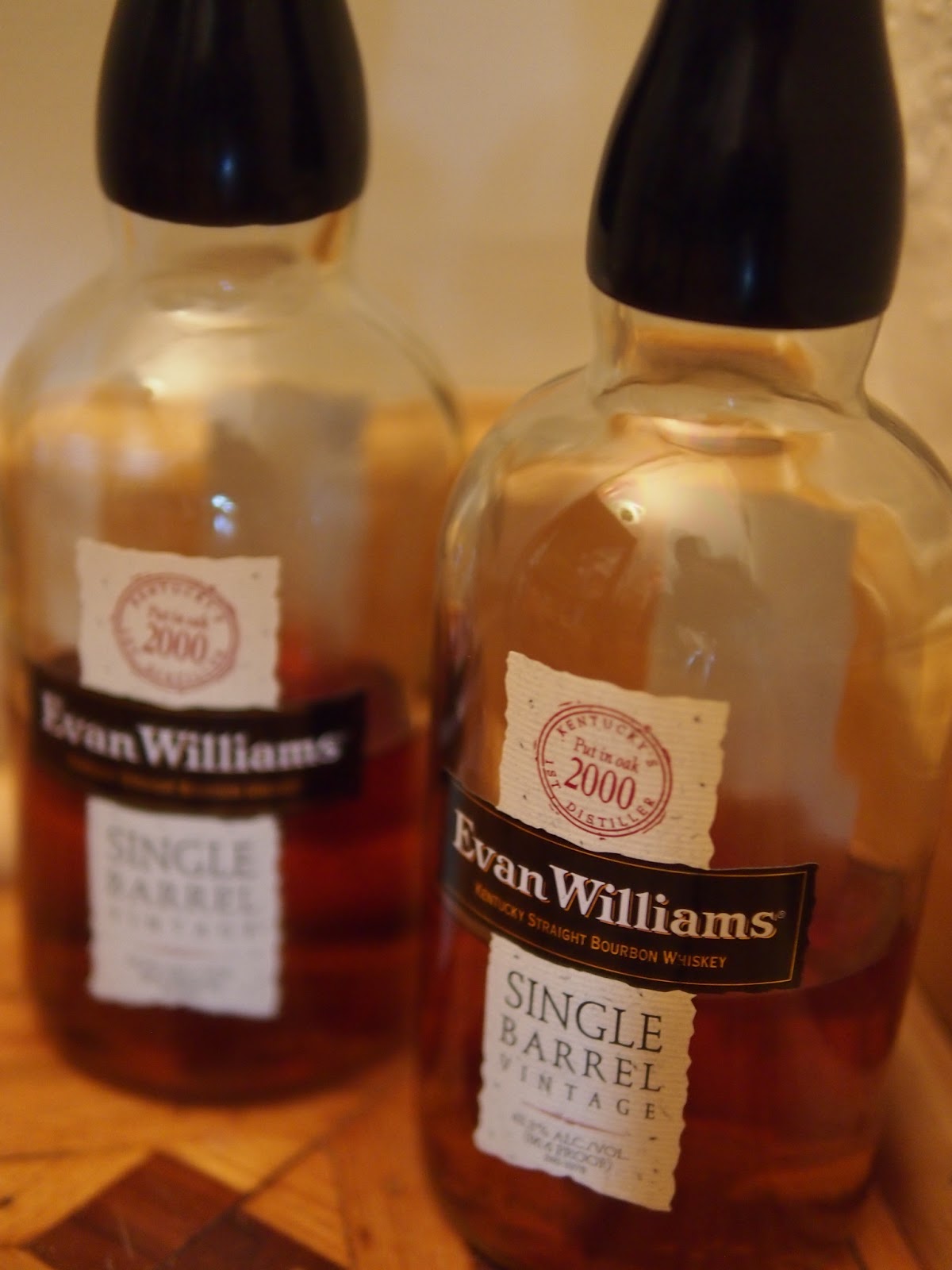
For our first comparison, we evaluated 2 bottles of Evan Williams Single Barrel, bottled in 2000. What makes this comparison potentially interesting is the variable known as barrel selection. The reason "single barrel" bourbons are potentially fun (but not always superior) is that they can show off just how different seemingly identical barrels can become. Bourbons distilled identically and aged for the same amount of time can differ for a few reasons. Warehouse placement may lead to a barrel experiencing more heat (often in the higher floors of the warehouse) leading to an increase in water evaporation and thus a concentration of flavor, color and alcohol. They may also be exposed to more dramatic temperature changes: this leads to more dramatic wood influence as the spirit is drawn more deeply into and out of the barrel staves. Differences in the barrels themselves may also impart differences (they are from non-identical trees after all); apparently the grain of the wood can also impact flavor. And sometimes, there seems to be no real way to know why one barrel is different from another. Here's a great video on Drink Spirits by Heaven Hill's Larry Kass about the subject. But on to the bourbons:
Evan Williams Single Barrel 2000, Barrel 655 vs Barrel 192 (Both 86.6 proof, 9 years old, $25)
This is an annual release from Heaven Hill, adhering to their standard 75/15/10 mashbill. Notably this is not actually a limited release as such; they continue bottling to meet demand each year. It has regularly been around 9 years old is reasonably priced and is a darling of critics, especially the 2000 vintage we opened: John Hansel gave it an incredibly high 95 points in Whisky Advocate, and most other reviews followed suit.
In this case, barrel 192 went to sleep in the wood 11/8/2000, while 655 stayed up until 12/16/2000
Barrel 655
Nose: Oak and polished furniture first, then vanilla buttercream, faint cloves, cinnamon and dried herbs.
Palate: Medium weight, obviously corn-heavy: popcorn, vanilla, some caramel. Hint of butter.
Finish: Flavors from the palate persist briefly, fading over 30s. Some roasted nuts and bitterness (hazelnuts?).
Overall: 80/100
Barrel 192
Nose: More muted. Corn and light vanilla predominate with a hint of sawdust.
Palate: More interesting with an incense spiciness, more cinnamon and cloves and more caramel. Some tannins here as well.
Finish: Nearly identical to the 655
Overall: 80/100
| Sitting in the corner |
These bourbons are "correct." Really they most evoke the thought: "Yep. That's bourbon." This is not necessarily a bad thing, it's just a really boring thing. If this were a student it would get a "C." The kind of "C" where you really want to give a "D," but you know they will just go bitching to the Dean for an appeal... I really wanted to like these.
Anyway if there is some interest that can be wrung from this experience is how different they are: the nose on the 655 was actually rather nice, while the palate on the 192 had significantly more wood and interest for me. We have no idea where the 95 point rating came from, but I suppose that it may illustrate how different single barrels offerings can be.
Given that the nose of 655 excelled and the palate of 192 won, we decided to vat them together and see what happened. While this was certainly no scientific experiment, we decided our "extremely small batch" bourbon was actually a small improvement, which I think argues for the potential benefits of "vatting" or "batching" (just don't say mixing as it implies the addition of neutral spirits), but more about that another day.
Greg's Thoughts:
As Ryan mentioned, these two are clearly bourbon, but just that. I think Heaven Hill deserves a good deal of respect on the consistency front as both barrels were very similar. As for differences, 655 had a slight edge in the nose, and 192 a slightly better palate, but both were pretty boring. In general, I have found that I prefer older American whiskey (old wheated bourbon and really old rye) that are at least 90 proof and neither of these bottles changes my opinion. At 9-ish years old there is plenty of age here - the vanilla and tannic notes are present and really nice - but I can't help but think that these bourbons would be much improved with a slight bump in proof to say 90-95 (all the Evan Williams single barrels that I have from 2000-2002 are 86.6). Oh yeah, and let's drop the cold filtration as well and leave in some of those possibly delicious fatty acids. Both are tasty and inexpensive whiskeys that would be excellent introductions to those new to bourbon - they are lower in alcohol and have no burn when drunk neat and offer very typical bourbon flavors.
But let's move on to why I am so critical of the Evan Williams bottles: Elijah Craig. More specifically, Elijah Craig 12 year and the recently departed Elijah Craig 18 year (more about that soon). The 12 year version is routinely available for sub $30 in my area while the 18 year was purchased for $42. Herein lies the issue. The EC 12 and Evan Williams can be had for the same price, and I liked the EC 12 more in every way. The additional age and proof gave it a better nose and longer finish. Plus, the 94 proof makes it a great candidate for a few ice cubes on a hot summer day. Now, if you are very sensitive to the drier notes that come from extra oak - they are definitely present here - then this may be a negative, but for me this is one of the great values in bourbon.
-----
Anyway, it gets better. This was only a warmup. Next we will look at the effects of aging (Elijah Craig 12 versus 18), the effect of proof and chill-filtration (EC12 versus Elijah Craig Barrel Proof), and just for fun we'll compare ECBP to Parker's Heritage Collection Mix of Mashbills.
Saturday, April 20, 2013
Evan Williams Black Label Review
While preparing my
upcoming series on EWSB, Elijah 12, 18, barrel proof and PHC, I realized
that I had not had the regular old black label in many, many years.
Picked up a 200ml at a really sketchy place while dusty hunting (found a
WT American Spirit!), so I thought I’d give him a shot for a quick
review as the basic prototype of the whole Heaven Hill Range. For comparison is a bottle of
EWSB 2000 (barrel 655).
Evan Williams KSBW, 43%ABV ($4.59 the 200ml, just found out it’s on sale for $11.50/ 750mL in PA)
Nose: Classic Heaven Hill and reminds me most of the Current VSOF. Mint, cinnamon lime rinds, caramel
Palate: Relatively thin, sweet entry. Lots of cinnamon and caramel. Vanilla is here but only a touch of actual “oak” flavor. Hint of light roast coffee.
Finish: Sweet and about 45s long. Echoes the palate and then finishes minty and with a very faint hint of gummy candy Overall I am shocked by how good this is. Where was this in college? Why would anyone drink JBW? Anyway, this will be my go to recommendation for anyone looking to save money and have a nice drink. 83/100
What is most notable is that this earns 3 points more than the EWSB for my palate (that review is upcoming). While the black is fresh and has a lot going on (especially like the cinnamon), the single barrel I have just tastes like very generic and watery bourbon (though the nose is trending toward nice.)
Evan Williams KSBW, 43%ABV ($4.59 the 200ml, just found out it’s on sale for $11.50/ 750mL in PA)
Nose: Classic Heaven Hill and reminds me most of the Current VSOF. Mint, cinnamon lime rinds, caramel
Palate: Relatively thin, sweet entry. Lots of cinnamon and caramel. Vanilla is here but only a touch of actual “oak” flavor. Hint of light roast coffee.
Finish: Sweet and about 45s long. Echoes the palate and then finishes minty and with a very faint hint of gummy candy Overall I am shocked by how good this is. Where was this in college? Why would anyone drink JBW? Anyway, this will be my go to recommendation for anyone looking to save money and have a nice drink. 83/100
What is most notable is that this earns 3 points more than the EWSB for my palate (that review is upcoming). While the black is fresh and has a lot going on (especially like the cinnamon), the single barrel I have just tastes like very generic and watery bourbon (though the nose is trending toward nice.)
Friday, April 12, 2013
Beam Bourbons Part 2: Small Batch Collection
Sorry for the short break, but I'm back, it's Friday and I finally have time for a tasting session.
Having started tasting the "Small Batch Collection" with the comparison of Basil Hayden's to its younger, OGD brethren, it is only natural to finish out the Small Batch Series. Unlike "single barrel," "small batch" is a term in the whiskey industry with no mutually agreed-upon definition. Operationally, it tends to mean a product produced in significantly smaller batches than the base level product (in this case "Jim Beam"). Also presumed (sometimes incorrectly) is the idea that these smaller batches allow the distiller to target a more specific profile through barrel selection favoring characteristics that might be otherwise obscured if they just mixed them all together.
The term and marketing idea itself was created by Booker Noe, then the master distiller at Jim Beam in 1987, and began with his namesake Booker's, a barrel-strength and unfiltered bourbon aged around 7 years. This was in the early days of premium bourbon offerings and was likely in response to offerings like Blanton's, the first single barrel bourbon, itself released in 1984. Since the release of Booker's, the Small Batch series has expanded and now includes:
Knob Creek KSBW 9 years old, 50% ABV ($32/ 750mL)
Nose: Oak, vanilla, earth and citrus first, then noticeable cinnamon candy. No trace of acetone or other volatile aromas. Intense overall and here the earthy yeasty quality is well matched by the other aromas.
Palate: Medium bodied with noticeable alcohol on the attack despite the 9 years. The palate brings more earth, lots of oaky/vanilla flavors, cinnamon, cloves and small amounts of orange. A bit hotter than would be preferred for a 9 year 100 proofer.
Finish: The initial finish continues the palate quite pleasantly and is rather warming, but then trails off quickly, leaving a faint and less than ideal bitterness.
On Ice: Interestingly, this is one of they few bourbons that I have had that can not only stand up to ice but improves on the rocks. Perhaps this should not be surprising as I'm sure most of the KC made is drunk in this fashion. I find that ice fixes the hot palate immediately, and brings much more prominent vanilla and clove notes to the fore. Apparent sweetness also increases. The only part that suffers is the nose, which becomes predictably more muted.
84/100 (but a champion on ice will be my go to once temperatures dictate ice in my drinks this summer)
Baker's KSBW 7 years old, 53.5% ABV (~$40/ 750mL)
Nose: Notable for much less Beam yeastiness. Very prominent caramel here as well as oak, honey, cloves and a wisp of acetone. More of a dry attic/ furniture oak aroma here.
Palate: Thinner than the Knob, but apparently less hot despite the increased alcohol. The palate here is much more balanced with caramel, toasted bread, and popcorn along with caramel, honey and vanilla. Very well balanced.
Finish: The finish is more focused on vanilla, has less of the bitterness I found in the Knob and fades gradually and more cleanly, leaving a note of apples.
Overall I like this one, and find it far more refined and pleasant to drink neat than the KC. It is on the generic side, but it is clear that this batch was selected from barrels than show an impressive degree of balance, versus the more raw intensity of the Knob Creek. This, as has been said elsewhere, seems a good crossover for brandy drinkers and I am now sad I missed the PA closeout sale of this ($25). For the full list price, though, it is a bit generic: it has no real flaws, but has little of special interest. I like the departure from the Beam house style into something more elegant, though.
87/100
Booker's KSBW 6-8 years old, 63.7% ABV, ($50)
Nose: Much more intense; round. Lots of earth, lots of vanilla. Seriously lots of vanilla. Otherwise more similar to the Knob than the Baker's, but I can't overstress how powerful the vanilla is here.
Palate: Good Christ. This is anesthetic at full proof, and while vanilla, oak and toast flavors arrive, they are fleeting and lost in the alcohol.
Finish: Alcohol and maybe some apples. Really just feels like GERD.
So, this is not really pleasant at full proof, as I think tends to be the case with most barrel strength American whiskies that reach into the 120s. Some bottles of Stagg are an exception; this is not. However, while I rarely enjoy a mouthful of alcohol like this, I do favor high proof bottles for the reason that you can taste them undiluted, and then make your own decision about how much water to add. And so:
Watered to 107 proof and rested for 5 min:
The nose remains very pleasant, with the vanilla toned down a bit and a bit more nuttiness coming forward along with some honey and citrus. Smells more like dessert than a bottle of vanilla extract and is really rather nice. The palate is really much improved as well and is very different from the Baker's despite similar age and proof. This is much more forward, still hotter, but sweeter and more focused on desert-like flavors than spices or oak. The finish too is more manageable and fades into apples, vanilla and a cooling sensation that I usually associate with good distillation.
87/100
Tasting these together, as I had hoped, has been an interesting exercise in the effect of barrel selection and (maybe) aging on flavor, considering they all enter barrels as basically identical spirits. The Knob Creek seems like it was designed to be iced, and in this capacity I will likely see it again this summer; even with the extra 2 years in oak factored in, this seems a very different bourbon from the other two.
The Booker's and Baker's comparison at 107 I think is the most illustrative: they are totally different. Baker's has a much more refined and balanced profile, though maybe to the point of boring, while the Booker's is much more aggressive if rough.
Overall these are all well-made and pleasant bourbons, but other than waiting for a sale to buy some Knob to drink in the rocks on my roof deck this summer, I probably won't buy these again. I like the other 2, but I just don't think they represent a good value at the prices for which I usually see them listed. The Booker's and Baker's are about equal to each other in price per proof, but the former is too rough and too much a vanilla bomb, while the latter lacks interest. There is just too much good competition for these to move me to spend $40-50. At a 15-20% discount, however, I might be swayed.
Having started tasting the "Small Batch Collection" with the comparison of Basil Hayden's to its younger, OGD brethren, it is only natural to finish out the Small Batch Series. Unlike "single barrel," "small batch" is a term in the whiskey industry with no mutually agreed-upon definition. Operationally, it tends to mean a product produced in significantly smaller batches than the base level product (in this case "Jim Beam"). Also presumed (sometimes incorrectly) is the idea that these smaller batches allow the distiller to target a more specific profile through barrel selection favoring characteristics that might be otherwise obscured if they just mixed them all together.
The term and marketing idea itself was created by Booker Noe, then the master distiller at Jim Beam in 1987, and began with his namesake Booker's, a barrel-strength and unfiltered bourbon aged around 7 years. This was in the early days of premium bourbon offerings and was likely in response to offerings like Blanton's, the first single barrel bourbon, itself released in 1984. Since the release of Booker's, the Small Batch series has expanded and now includes:
- Booker's: aged 7 years, 120–129.2 proof (60–64.60% ABV)
- Baker's: aged 7 years, 107 proof (53.5% ABV)
- Basil Hayden's: aged 6-8 years, 80 proof (40% ABV); recently lost it's age statement.
- Knob Creek: aged 9 years, 100 proof (50% ABV), with a 9 year, 120 proof (60% ABV) single barrel expression.
Knob Creek KSBW 9 years old, 50% ABV ($32/ 750mL)
Nose: Oak, vanilla, earth and citrus first, then noticeable cinnamon candy. No trace of acetone or other volatile aromas. Intense overall and here the earthy yeasty quality is well matched by the other aromas.
Palate: Medium bodied with noticeable alcohol on the attack despite the 9 years. The palate brings more earth, lots of oaky/vanilla flavors, cinnamon, cloves and small amounts of orange. A bit hotter than would be preferred for a 9 year 100 proofer.
Finish: The initial finish continues the palate quite pleasantly and is rather warming, but then trails off quickly, leaving a faint and less than ideal bitterness.
On Ice: Interestingly, this is one of they few bourbons that I have had that can not only stand up to ice but improves on the rocks. Perhaps this should not be surprising as I'm sure most of the KC made is drunk in this fashion. I find that ice fixes the hot palate immediately, and brings much more prominent vanilla and clove notes to the fore. Apparent sweetness also increases. The only part that suffers is the nose, which becomes predictably more muted.
84/100 (but a champion on ice will be my go to once temperatures dictate ice in my drinks this summer)
Baker's KSBW 7 years old, 53.5% ABV (~$40/ 750mL)
Nose: Notable for much less Beam yeastiness. Very prominent caramel here as well as oak, honey, cloves and a wisp of acetone. More of a dry attic/ furniture oak aroma here.
Palate: Thinner than the Knob, but apparently less hot despite the increased alcohol. The palate here is much more balanced with caramel, toasted bread, and popcorn along with caramel, honey and vanilla. Very well balanced.
Finish: The finish is more focused on vanilla, has less of the bitterness I found in the Knob and fades gradually and more cleanly, leaving a note of apples.
Overall I like this one, and find it far more refined and pleasant to drink neat than the KC. It is on the generic side, but it is clear that this batch was selected from barrels than show an impressive degree of balance, versus the more raw intensity of the Knob Creek. This, as has been said elsewhere, seems a good crossover for brandy drinkers and I am now sad I missed the PA closeout sale of this ($25). For the full list price, though, it is a bit generic: it has no real flaws, but has little of special interest. I like the departure from the Beam house style into something more elegant, though.
87/100
Booker's KSBW 6-8 years old, 63.7% ABV, ($50)
Nose: Much more intense; round. Lots of earth, lots of vanilla. Seriously lots of vanilla. Otherwise more similar to the Knob than the Baker's, but I can't overstress how powerful the vanilla is here.
Palate: Good Christ. This is anesthetic at full proof, and while vanilla, oak and toast flavors arrive, they are fleeting and lost in the alcohol.
Finish: Alcohol and maybe some apples. Really just feels like GERD.
So, this is not really pleasant at full proof, as I think tends to be the case with most barrel strength American whiskies that reach into the 120s. Some bottles of Stagg are an exception; this is not. However, while I rarely enjoy a mouthful of alcohol like this, I do favor high proof bottles for the reason that you can taste them undiluted, and then make your own decision about how much water to add. And so:
Watered to 107 proof and rested for 5 min:
The nose remains very pleasant, with the vanilla toned down a bit and a bit more nuttiness coming forward along with some honey and citrus. Smells more like dessert than a bottle of vanilla extract and is really rather nice. The palate is really much improved as well and is very different from the Baker's despite similar age and proof. This is much more forward, still hotter, but sweeter and more focused on desert-like flavors than spices or oak. The finish too is more manageable and fades into apples, vanilla and a cooling sensation that I usually associate with good distillation.
87/100
Tasting these together, as I had hoped, has been an interesting exercise in the effect of barrel selection and (maybe) aging on flavor, considering they all enter barrels as basically identical spirits. The Knob Creek seems like it was designed to be iced, and in this capacity I will likely see it again this summer; even with the extra 2 years in oak factored in, this seems a very different bourbon from the other two.
The Booker's and Baker's comparison at 107 I think is the most illustrative: they are totally different. Baker's has a much more refined and balanced profile, though maybe to the point of boring, while the Booker's is much more aggressive if rough.
Overall these are all well-made and pleasant bourbons, but other than waiting for a sale to buy some Knob to drink in the rocks on my roof deck this summer, I probably won't buy these again. I like the other 2, but I just don't think they represent a good value at the prices for which I usually see them listed. The Booker's and Baker's are about equal to each other in price per proof, but the former is too rough and too much a vanilla bomb, while the latter lacks interest. There is just too much good competition for these to move me to spend $40-50. At a 15-20% discount, however, I might be swayed.
Tuesday, March 19, 2013
Wild Turkey: Then and Now
Old # 8 vs Current 101. A Blinded Trial
IntroductionThis bottle of Wild Turkey Old #8, 101 proof was my first successful dusty find. Squirreled away in a terrible shop in Gloucester, NJ, and protected by an almost insurmountable wall of cat urine odor, I was inordinately pleased to find this. I have been hoping for some time to find some 8 or 12 year old Turkey, but this is a fine start. I've been carefully having a sip now and then and marveling over how good it is. "They don't make it like this anymore." But I guess that's more of a testable hypothesis than a statement of opinion, really.
Old #8 was a short-lived product put out as a transition from the 8 year-old 101 proof that had been their longtime stalwart. Like George Dickel and others, a change from 8 years old to #8 brand still left a prominent "8" on the bottle for an unwary consumer. The initial few years of the Old #8 in the early nineties (our special occasion bourbon in college) were considered great and largely equivalent to the 8yo. Turkey afficionados (I'm more of an admirer), would say the #8 went downhill until the late 1990s, when they dropped the age statement and that it has gone downhill since then: The age has been dropping, they've put out lower proof versions and their entry proof has gone up (lower entry proofs typically extract more flavor, but use more barrels per bottle of whiskey). That said, my casual encounters (Southwest flights, neighborhood bars) over the years have remained positive, so maybe it is memory that is faulty.
Methods
Two identical Glencairn glasses were filled with 30g of bourbon (WT#8, WT101) each, after being first rinsed with water and then rinsed with a small amount of the respective bourbon to eliminate any contaminants or effects of the water rinse. The glasses were then placed on identical coasters, one of which had been marked (the WT101). The glasses were then randomized and presented to me for tasting. I tasted them sequentially, eating a wheat cracker and taking 4oz filtered water before each. Drams were tasted against a black countertop to prevent differences in color from unblinding. Most of each sample was taken orally and then expectorated to avoid accidental intoxication from impacting the results.
Results
Bourbon 1 Tasting
The nose is revealing of sawn and toasted wood notes, along with a hint of ground coffee. Caramel, vanilla bean and waxy notes follow with some swirling, as I find typical of WT product. Really a perfect dessert bourbon nose. The palate is middle weight with very prominent rye spices, and a good level of sweetness that is balanced by char and tannins. The wax is back here as well, along with smoke and incense, giving a slightly Novena-like flavor. The alcohol is well tamed for 101 proof. The finish is medium to quick in length, pleasantly warm and slightly bitter at the end. This is very good and very typical high-rye bourbon, though not particularly exceptional.
Bourbon 2 Tasting
The nose is similar to Bourbon 1, with the addition of more acetone/organic notes, making me think the cut was wider on this. Also more vanilla and cognac-like notes. The palate is heaver, with spice, chocolate, coffee, toffee, butter and dark tannic wood flavors. Syrupy, but the sweetness is again well balanced with acid and tannin. The alcohol is more evident here. The finish is very long, drying and warming, reminiscent of a much older spirit than either of these is. This is all Bourbon 1 is, but better. To borrow a term from the brits, this is very moreish. Clearly, I think this is the Old #8.
Unblinding
I was totally wrong. I liked the second one better. The more prominent alcohol and slightly more muted spice character are the only departments in which the new version fell short.
Conclusion
I'm a little disappointed to have been wrong, but since I've not had the current 101 in a long time, I'm not too concerned about my tasting acumen. However, this is the best possible outcome. I like this better than the dusty and better than the Rare Breed I had a few months back. More importantly, I never have to go back to cat-pee-store again! Maybe the #8 was from the tail end when it was nto so good, but in any case, I shall drink more turkey in the future. Aside from the comparison, they were both very good; my bottle of 101 bordered on excellent. I'm interested to try the RR single barrel, but this, at only $23, is pretty compelling stuff.
Sunday, March 17, 2013
Wheaters Part 6: Pappy 15, Jefferson's 18, and Vintage 17 Bourbon Review
Wheaters Finale: The Best 3 Wheaters Under $100?
Including, in my opinion, the best wheater at any price I've had.
Welcome to the last installment of this series on wheated bourbons. I have found, in drinking the spiritual heirs to Stizel-Weller that there are some very good whiskies in this segment, and that price does not always equal quality. I have also found the market to be a bit crowded with a number of expressions that I don't have a lot of time for. This is because, in my now reasonably extensive experience, wheaters really only become impressive after fairly protracted aging, around 12 years. I find wheated bourbons younger than this to be good, easy-drinking spirits, but I can't say that they offer much to my palate beyond standard low-rye bourbons. I think it is a shame to drink in their youth such bourbons as these will become in their age. I'm sure I will enrage OWA and Maker's die hards, but de gustibus non est disputandum.
I have also decided to finish the series here, with these three, and leave critical reviews of the Old Rip and OWA for another time. I'm getting a bit of wheater fatigue, and you too may be hoping I will move on. So, tasted neat (as I just really can't enjoy water in my bourbon unless it starts at over 50%):
Vintage Bourbon 17*
47% ABV Bottled by Kentucky Bourbon Distillers, $64.99
This prosaically named and hideously packaged bourbon was likely distilled at the Bernheim while it was owned by United Distillers. At this time, UD had just closed the S-W plant and were producing Old Fitzgerald and Weller products there (the plant would later be sold to Heaven Hill and the Weller brand to Sazerac). Some of the bourbons in the Van Winkle line have a proportion of this distillate as well. As such, this stuff has a pretty good pedigree (unfortunately, it seems to have been discontinued and, like many non-distiller labels, it is impossible to confirm any of this).
Nose: When poured into the fancy snifter I decided on today it fills the room with buttered apples. It smells like pie is about to happen.The nose also has some well-tamed alcohol, brown sugar, and no hint of acetone or other organic compounds.
Palate: The mouthfeel is weighty and smooth. The initial attack brings caramel, more buttered apple, pastry dough and a higher than average level of sweetness.
Finish: moderate length, very warming and pleasant. Apples and pears continue for some time, and no bitterness or real burn is detected. This one really asks you to have another sip.
Overall this is a very well-done effort. If it has a failing, it is somewhat simple and sweeter than average. However, with it's intense and pleasant flavor profile and very nicely integrated oak, the apple pie and sweetness thing makes this an exceptional desert bourbon and cognac alternative. I just wish I had more.
Jefferson's Presidential Select, 18 Years Old KSBW
Batch #27, 47% ABV, Bottled by McLain and Kyne, $89.99
Like the JPS17 that I had and loved last year, this bourbon was distilled in 1991 at the Stitzel-Weller distillery before it closed. Unusual for an independent bottler to tell us where the bourbon comes from, but in a world where kidneys are sold to get a bottle of Pappy, the S-W name sells. M&K do have a 21 year JPS coming out, but it looks unlikely to be from S-W or even wheater. But on to this one:
Nose:Wood. Woody, woody wood. Sort of nice wood, though, like walking into an antique shop in New England. Some incense, some cherries in there somewhere, vanilla and maybe a hint of milk chocolate. Orange zest too? All of the latter are initially overpowered by the wood, but as the wood blows off, they come to the forefront.
Palate: Again woody. There initial sweetness with vanilla and caramel, as well as faint cherry and maple, but it then feels like it dries up and falls into a hole: the midpalate is full of dried grass, dried wheat and pencil shavings. There is also some bitterness toward the end.
Finish: The finish is long, but that nagging, grassy note dominates. Also pencil wood, citrus and some faint spices.
Overall, I'm finding this a lot less pleasant than the 17, as well as the last glass I had in a bar. I suppose batch variation is a partial culprit, but I really think they left this guy in the barrel way too long. As I mentioned in a previous post, this stuff really comes alive with a few drops of Stagg, and I found the same with the addition of a few drops of Pappy 15. In both cases it was totally salvaged and really enjoyable. But I think $90 is too much to ask for a bourbon that needs "correcting." It is probably still worth trying, just to get some S-W into you, if you've never been exposed, and also worth seeking out if you can find a better batch than this one.
Pappy Van Winkle's Family Reserve, 15 Years Old KSBW
53.5% ABV, Bottled by Old Rip Van Winkle Distillery, $99.99
Pappy. Just saying the name makes liquor store owners shudder. As the most sought-after bourbon in the world, it's popularity at this point is based mostly on the fact that you cannot buy it anywhere. It used to come out twice a year, with the 15 year around $50-60; it's now down to every fall for $100 in many places, and we see it on Craigslist and (illegally) on Ebay for hundreds more than that. It's become the holy grail of bourbon hipsterdom and a great illustration of the fact that nothing makes people want something more than to be told they can't have it.
The 15 year was initially introduced as a line extension to the original, 20 year-old Pappy (a 23 was also introduced), which I find more refined but less pleasurable at its lower proof. My one tasting of the 23 is lost in the mists of time. The bottle I have in front of me is likely a mixture of bourbons from Bernheim (like the V17), S-W (like the JPS18) and Buffalo Trace. Eventually it will (like the current Old Rip) be a 100% BT product.
Nose: When poured, the room again fills with the buttered apple aroma as with the Vintage 17. The oak is also there, more like the JPS and with the same antique-store and incense note. Cherries are also present as are caramel and vanilla. It is easy to smell what each of the Bernheim and S-W bourbons bring to this; harder to say with the BT, but their products are relatively neutral and 'clean' overall so this may not be surprising. This is a much better balanced nose than the JPS and more complex and interesting than the V17.
Palate: The attack is more aggressive here, likely due to the higher proof. There is butter, a touch of acetone, vanilla, brown sugar, dulce de leche,apples and a hint of coffee. The sweetness is medium and the body is huge.
Finish: the finish echoes the palate and, by virtue of the 53.5%, goes on for days. It is very warming and satisfying, leaving apples as a final note. There are no off notes and when the finish finally fades, the mouth feels clean.
I'd like to be contrarian and say that the PVW is more hype than substance, but I could honestly drink this stuff for days. It is really the platonic wheated bourbon and I can think of no way to improve upon it. It was the best value in the whiskey world when it was $60, and it remains well worth the $100. Why is it so good? I have a few ideas:
Conclusions
After all of these wheated bourbons, I will continue to buy Pappy 15, provided it doesn't reach much higher prices. I will also not turn down a Vintage 17 if I find it. I think I may well hoard a small amount of Weller 12, for when I'm in the mood for a wheater and it's not a special occaision, and I will also buy more of the Old Rip, which is supposed to be in better supply this fall. It'll be twice as expensive as OWA, but I think it's twice as good. I will probably not be buying any more Van Winkle 12 (lot B), any more OWA or WSR and will probably make my WLW decisions on a case-by-case basis. I am fortunate enough to have a hoard of Pappy and WLW that would see me through a medium-sized zombie apocalypse, so I think I will likely overall shift my money away from wheaters.
This leads me to a final thought. I love Pappy, and I really like most of the wheaters I've tasted. However, to my palate, only the PVW has held a candle to George Stagg, Van Winkle Rye, Sazerac 18, Hirsch 22, or special editions of Four Roses. I know I don't like wheaters as much as straight ryes, and I'm beginning to wonder about my feelings about them compared to high-rye bourbons... I guess that might be the next series to discuss.
If forced to rank-order and give scores to the wheaters I've had this year since (with price as a consideration), I would rate them:
99/100 Pappy 15
94/100 Vintage 17, William Larue Weller
92/100 Weller 12
89/100 Van Winkle 12,
88/100 Jefferson's Presidential 18
79/100 Rebel Yell
*Note that older expressions of Vintage 17 were actually rye recipe bourbons
** I use Vatting, versus blending, as the latter connotes the blending of bourbon with inferior grain spirits as is "blended whiskey," aka bourbon flavored vodka.
Including, in my opinion, the best wheater at any price I've had.
Welcome to the last installment of this series on wheated bourbons. I have found, in drinking the spiritual heirs to Stizel-Weller that there are some very good whiskies in this segment, and that price does not always equal quality. I have also found the market to be a bit crowded with a number of expressions that I don't have a lot of time for. This is because, in my now reasonably extensive experience, wheaters really only become impressive after fairly protracted aging, around 12 years. I find wheated bourbons younger than this to be good, easy-drinking spirits, but I can't say that they offer much to my palate beyond standard low-rye bourbons. I think it is a shame to drink in their youth such bourbons as these will become in their age. I'm sure I will enrage OWA and Maker's die hards, but de gustibus non est disputandum.
I have also decided to finish the series here, with these three, and leave critical reviews of the Old Rip and OWA for another time. I'm getting a bit of wheater fatigue, and you too may be hoping I will move on. So, tasted neat (as I just really can't enjoy water in my bourbon unless it starts at over 50%):
Vintage Bourbon 17*
47% ABV Bottled by Kentucky Bourbon Distillers, $64.99
This prosaically named and hideously packaged bourbon was likely distilled at the Bernheim while it was owned by United Distillers. At this time, UD had just closed the S-W plant and were producing Old Fitzgerald and Weller products there (the plant would later be sold to Heaven Hill and the Weller brand to Sazerac). Some of the bourbons in the Van Winkle line have a proportion of this distillate as well. As such, this stuff has a pretty good pedigree (unfortunately, it seems to have been discontinued and, like many non-distiller labels, it is impossible to confirm any of this).
Nose: When poured into the fancy snifter I decided on today it fills the room with buttered apples. It smells like pie is about to happen.The nose also has some well-tamed alcohol, brown sugar, and no hint of acetone or other organic compounds.
Palate: The mouthfeel is weighty and smooth. The initial attack brings caramel, more buttered apple, pastry dough and a higher than average level of sweetness.
Finish: moderate length, very warming and pleasant. Apples and pears continue for some time, and no bitterness or real burn is detected. This one really asks you to have another sip.
Overall this is a very well-done effort. If it has a failing, it is somewhat simple and sweeter than average. However, with it's intense and pleasant flavor profile and very nicely integrated oak, the apple pie and sweetness thing makes this an exceptional desert bourbon and cognac alternative. I just wish I had more.
Jefferson's Presidential Select, 18 Years Old KSBW
Batch #27, 47% ABV, Bottled by McLain and Kyne, $89.99
Like the JPS17 that I had and loved last year, this bourbon was distilled in 1991 at the Stitzel-Weller distillery before it closed. Unusual for an independent bottler to tell us where the bourbon comes from, but in a world where kidneys are sold to get a bottle of Pappy, the S-W name sells. M&K do have a 21 year JPS coming out, but it looks unlikely to be from S-W or even wheater. But on to this one:
Nose:Wood. Woody, woody wood. Sort of nice wood, though, like walking into an antique shop in New England. Some incense, some cherries in there somewhere, vanilla and maybe a hint of milk chocolate. Orange zest too? All of the latter are initially overpowered by the wood, but as the wood blows off, they come to the forefront.
Palate: Again woody. There initial sweetness with vanilla and caramel, as well as faint cherry and maple, but it then feels like it dries up and falls into a hole: the midpalate is full of dried grass, dried wheat and pencil shavings. There is also some bitterness toward the end.
Finish: The finish is long, but that nagging, grassy note dominates. Also pencil wood, citrus and some faint spices.
Overall, I'm finding this a lot less pleasant than the 17, as well as the last glass I had in a bar. I suppose batch variation is a partial culprit, but I really think they left this guy in the barrel way too long. As I mentioned in a previous post, this stuff really comes alive with a few drops of Stagg, and I found the same with the addition of a few drops of Pappy 15. In both cases it was totally salvaged and really enjoyable. But I think $90 is too much to ask for a bourbon that needs "correcting." It is probably still worth trying, just to get some S-W into you, if you've never been exposed, and also worth seeking out if you can find a better batch than this one.
Pappy Van Winkle's Family Reserve, 15 Years Old KSBW
53.5% ABV, Bottled by Old Rip Van Winkle Distillery, $99.99
Pappy. Just saying the name makes liquor store owners shudder. As the most sought-after bourbon in the world, it's popularity at this point is based mostly on the fact that you cannot buy it anywhere. It used to come out twice a year, with the 15 year around $50-60; it's now down to every fall for $100 in many places, and we see it on Craigslist and (illegally) on Ebay for hundreds more than that. It's become the holy grail of bourbon hipsterdom and a great illustration of the fact that nothing makes people want something more than to be told they can't have it.
The 15 year was initially introduced as a line extension to the original, 20 year-old Pappy (a 23 was also introduced), which I find more refined but less pleasurable at its lower proof. My one tasting of the 23 is lost in the mists of time. The bottle I have in front of me is likely a mixture of bourbons from Bernheim (like the V17), S-W (like the JPS18) and Buffalo Trace. Eventually it will (like the current Old Rip) be a 100% BT product.
Nose: When poured, the room again fills with the buttered apple aroma as with the Vintage 17. The oak is also there, more like the JPS and with the same antique-store and incense note. Cherries are also present as are caramel and vanilla. It is easy to smell what each of the Bernheim and S-W bourbons bring to this; harder to say with the BT, but their products are relatively neutral and 'clean' overall so this may not be surprising. This is a much better balanced nose than the JPS and more complex and interesting than the V17.
Palate: The attack is more aggressive here, likely due to the higher proof. There is butter, a touch of acetone, vanilla, brown sugar, dulce de leche,apples and a hint of coffee. The sweetness is medium and the body is huge.
Finish: the finish echoes the palate and, by virtue of the 53.5%, goes on for days. It is very warming and satisfying, leaving apples as a final note. There are no off notes and when the finish finally fades, the mouth feels clean.
I'd like to be contrarian and say that the PVW is more hype than substance, but I could honestly drink this stuff for days. It is really the platonic wheated bourbon and I can think of no way to improve upon it. It was the best value in the whiskey world when it was $60, and it remains well worth the $100. Why is it so good? I have a few ideas:
- Vatting: in a market where single barrel automatically equals good, I think we can forget too easily the benefits of vatting.** Just as I found adding Stagg or Pappy to the JPS, using bourbons with slightly different profiles can often provide complexity and bolster weaknesses in a way that might not otherwise be possible. I think this is an approach that not used enough. As a caveat, though: I wish they would tell us when they did it and with what; there needs to be more transparency.
- Proof: a given barrel of bourbon has all the flavor it's ever going to have. Adding water doesn't just cut down the alcohol. PVW15 has an extra 6.5% on the other guys, which is more than enough to make a difference.
- Age and aging conditions: Given long enough in a barrel, I feel like all spirits tend toward "extra aged" in nose and taste. When done well, it's lovely, as in XO cognac, aged scotch, extra añejo tequila or Pappy 20, for that matter. However, in the hot climate of Kentucky, it is easy to let a spirit age to far, resulting in the unpleasant woodiness we found in the JPS18. I think the Pappy 15 was dumped just as the barrels gave all they could, while preserving the qualities of the spirit that make it bourbon.
Conclusions
After all of these wheated bourbons, I will continue to buy Pappy 15, provided it doesn't reach much higher prices. I will also not turn down a Vintage 17 if I find it. I think I may well hoard a small amount of Weller 12, for when I'm in the mood for a wheater and it's not a special occaision, and I will also buy more of the Old Rip, which is supposed to be in better supply this fall. It'll be twice as expensive as OWA, but I think it's twice as good. I will probably not be buying any more Van Winkle 12 (lot B), any more OWA or WSR and will probably make my WLW decisions on a case-by-case basis. I am fortunate enough to have a hoard of Pappy and WLW that would see me through a medium-sized zombie apocalypse, so I think I will likely overall shift my money away from wheaters.
This leads me to a final thought. I love Pappy, and I really like most of the wheaters I've tasted. However, to my palate, only the PVW has held a candle to George Stagg, Van Winkle Rye, Sazerac 18, Hirsch 22, or special editions of Four Roses. I know I don't like wheaters as much as straight ryes, and I'm beginning to wonder about my feelings about them compared to high-rye bourbons... I guess that might be the next series to discuss.
99/100 Pappy 15
94/100 Vintage 17, William Larue Weller
92/100 Weller 12
89/100 Van Winkle 12,
88/100 Jefferson's Presidential 18
79/100 Rebel Yell
*Note that older expressions of Vintage 17 were actually rye recipe bourbons
** I use Vatting, versus blending, as the latter connotes the blending of bourbon with inferior grain spirits as is "blended whiskey," aka bourbon flavored vodka.
Sunday, March 10, 2013
Wheaters part 4: The Great Wheater Night
Wheater Night
We might have gone a bit overboard with this one. My friend Greg and I finally got to have a whiskey night after a long interval. Reviews of the Pappy Van Winkle 15, Jefferson's Presidential Reserve 18, Vintage 17, William Larue Weller, Old Weller Antique and Old Rip Van Winkle will follow.
The point of this evening was to take a broad survey of high-end wheaterdom and compare in a few cases to more standard offerings to get a feel for the actual value added by the more expensive and harder to get bottles. We also tried or hand at a couple vattings (not so insane when you remember that PVW and lot B have often been vattings of different bourbons). It's really great to be able to try everything together to allow comparisons and really bring perspective. Here are our most notable thoughts:
Buffalo Trace
Other Wheaters
Vatting
| It was ambitious |
The point of this evening was to take a broad survey of high-end wheaterdom and compare in a few cases to more standard offerings to get a feel for the actual value added by the more expensive and harder to get bottles. We also tried or hand at a couple vattings (not so insane when you remember that PVW and lot B have often been vattings of different bourbons). It's really great to be able to try everything together to allow comparisons and really bring perspective. Here are our most notable thoughts:
Buffalo Trace
- Pappy 15 is an awesome, just incredible, perfect wheated bourbon. It roundly beat everything else here and we both agree we like it better than the Pappy 20 (which we did not open last night). I don't have a clear enough memory of the Pappy 23 from my one tasting, but I think I would always pick 3 15's over a 23. At $100 this is not inexpensive but may be the best bourbon currently made and certainly ranks among the best $100 whiskeys of any kind. The only thing I can say to temper this is that I'm not sure that the best wheater really beats the best straight ryes, but that is personal preference.
- Buffalo Trace makes too many wheaters. We think they should consider discontinuing Lot B. The best bottles of Weller 12 are as good, and less stellar examples are still well worth the $25. Lot B is too expensive and too hard to find. If we got rid of it, Weller 12 could be more available.
- Along similar lines, we think that Old Weller Antique should go. Screaming OWA fans hear me out: OWA is a very nice value bourbon, but if we had more access to either Weller 12, or ORVW 10/107 (which these OWA barrels grow up to be) I think we could live without the OWA. We need to stop tapping these barrels in the flower of their youth and wait until they are the far superior 10-12 year-old versions. I guess we could keep the WSR as an incredible value alternative to Maker's.
- WLW can also go: obviously a well-selected barrel-proof Weller 12, we could stop fooling around with this and make more W12 available. While we are at it, why not put the Weller 12 in a nicer bottle at 100 proof, charge a touch more and split the difference.
- Because of all of the above, our dream lineup BT wheaters would be a pared-down roster of WSR, ORVW 10/107, Weller 12/100 and PVW15. This would maximize all that is good and right about BT wheaters while perhaps helping availability. The PVW 20 and 23 should obviously live on as limited editions.
Other Wheaters
- The Vintage 17 wheater was really, really nice. A KBD-bottled wheater made at Bernheim with KBD's usual flair for creative names. Too bad this stuff is no longer made.
- The JPS18 was not as good as the JPS17. The extra year seems to have done it no favors.
Vatting
- The 50:50 blend of OWA and W12 made popular on Straight Bourbon remains a great thing, though the nose is better than the palate.
- A step-up version of the above with ORVW and W12 was incredible, and was the inspiration for our plea for W12/100.
DIY Hirsch 16- The best nose of any American Whiskey we have ever encountered!
- The best, and perhaps most heretical vatting was one I conceived during my only experience with Hirsch 16. I enjoyed it after some JPS 18 and at the time thought that they were similar but that the H16 brought much more enjoyable rye complexity to the midpalate as well as more of the acetone notes I enjoy in PVW and George T. Stagg. So we did the obvious: added GTS drop by drop to JPS18 until the grassiness faded from the midpalate and was replaced by all of the intense rye-bourbon notes we love about the Stagg. The nose on this stuff was staggering. I'm not going to compare it to the Hirsch, but I would encourage any of you whiskey nerd with both of these open to try it. As Greg put it, "Stagg might be the white truffle of the bourbon world - an expensive, exotic, wonderful flavoring ingredient that is best not consumed by itself."
Friday, February 22, 2013
Rebel Yell Review: Wheaters Part 1
| Maybe it's because I'm a Yankee? |
The name Rebel Yell refers to the battle cry of the Confederacy during the American Civil War. The whiskey itself was initially a Stizel-Weller brand, named by the then-mayor of Louisville, Charles Farnsley, to commemorate the 100th anniversary of S-W in 1949, and was distributed "especially for the deep south."
This was a product made using a wheated bourbon mashbill at S-W until the plant closed in 1992. It is currently made at Heaven Hill's new Bernheim distillery under contract for Luxco, who also market Ezra Brooks.
Made perhaps more famous by the Billy Idol song, which was itself inspired by the Rolling Stones' apparent enthusiasm for the bourbon, the S-W of that time is long gone; so how will this guy drink out? Apparently a group review by Sku, Jason Pyle and Tim Read did not go so well, but as I don't know those guys (though their blogs are great), I'm going to make up my own mind. Besides, apart from all of the obvious controversy of Confederate themed things, this somehow connected with pleasant memories of Dukes of Hazard watched on the living room floor during my few childhood years in Georgia.
Still made using a wheated mashbill (like all the ex-S-W brands except Cabin Still), this bourbon is labeled as Straight Bourbon without an age statement (so at least 4 years) and bottled at an uninspiring 80 proof, the legal minimum for bourbon.
Appearance
In the glass, the RY pours a very light color, say apple juice or maybe something more personally biological. Maybe it's the heavy dilution, but this is likely also very close to the minimum 4 years.
Nose
This smells like wheated bourbon, from far away. I got my nose wet trying to actually smell it. I get faint caramel, a touch of pine resin, some nondescript graininess (wheat crackers, cooked pasta?), and prominent alcohol despite the low proof. Also here and there a wisp of bubblegum that is not at all welcome. (edit: I think this is actually a dance party fog machine smell).
Palate
Dear god this is young. Very hot on the palate for 80 proof. Sweet, but only a little of the vanilla and caramel flavors that usually accompany oak sweetness. Cereal grains and some bitterness. I'd be lying if I said I could find much else.
Finish
So far, the stuff has been boring, but inoffensive. The finish, while not too harsh from the alcohol burn point of view, is objectionable. The initial finish is sweet but then quickly turns bitter with a rancid corn-oil note. It leaves the mouth feeling unclean, greasy and, somehow, guilty.
I live in Pennsylvania. This is the only wheater under $20 I can buy locally. I wanted it to be better. I knew it wasn't going to be great, but it takes a special kind of bourbon to let me down at the $13 price point. But this. This is pointless.
This bourbon makes me sad for the world. I'm going to go lie down. I'll have a review of some Weller and Van Winkle products soon. I'm just sorry.
Wednesday, February 20, 2013
Children of the Wheat
S-W Bourbons and Their Descendants
The proportion of bourbon articles in the last few months mentioning either Maker's "new Coke" manuver or Pappy Van Winkle's elusive awesomeness makes me think a discussion of wheaters is in order.
A traditional bourbon is, at its heart, a spirit made from corn, with a touch of barley added for its enzymes to aid fermentation. Most bourbons have rye grain added to this mashbill to add flavor: tradionally around 15%, but up to 35% in the case of "high-rye" bourbons, such as Four Roses. "Wheaters" use wheat instead of rye for the flavoring grain (typically around 75:15:10). A story has been around for years that this began with Bill Samuels baking a bunch of bread of different recipes, not having had time to distill and age different mashbills, and liked the wheat recipe the best, thus the Maker's mashbill was born. This story is almost certainly pure bullshit, as the mashbill, and much other initial assistance was given to him by Julian "Pappy" Van Winkle, Sr., in the 1950s.
The real history of wheated bourbon is an interesting and slightly incestuous one. The best illustration of this is to behold a bottle of my favorite wheater, Pappy Van Winkle Family Reserve 15 year-old bourbon. Depending on when the bottle was released it will be composed of up to 3 different wheated bourbons: those from Buffalo Trace (current producers of all new bourbon to be bottled as Van Winkle), The New Bernheim Distillery in Louisville and the (soon to reopen?) Stitzel-Weller distillery (read more about this on John Hansell's blog). The latter is the spiritual home of wheated bourbon.
Van Winkle and Weller
| Julian Sr., before he was "Pappy" |
- Pappy Van Winkle Family Reserve 23 years old (95.6 proof)
- Pappy Van Winkle Family Reserve 20 years old (90.4 proof)
- Pappy Van Winkle Family Reserve 15 years old (107 proof)
- Van Winkle Family Reserve Bourbon (Lot B) 12 years old (90.4 proof)
- Old Rip Van Winkle Handmade Bourbon 10 years old (107 proof)
In addition to the VW bourbons, buffalo trace also produces the Weller line, which was briefly also produced by the Bernheim distillery after the closure of S-W. This line currently includes
- W.L. Weller Special Reserve (90 proof)
- Old Weller Antique (107 proof)
- W.L. Weller 12 years old (90 proof)
- William Larue Weller (part of the BTAC, barrel proof varies by year)
Bernheim
Historically, there have been 2 Bernheim Distilleries, which causes some confusion. The orginal Bernheim distillery was previously known as the Pleasure Ridge Park Distillery until I.W. Bernheim, his brother Bernard, and a partner, Nathan Uri bought it and renamed it the Bernheim Distillery Co. Their aim was to make an elite bourbon brand, I.W. Harper, which they continued to make through prohibition (as a medicinal whiskey). They sold the business to the Schenley Distilling company in 1937. This distillery, would eventually produce the Cream of Kentucky Rye featured in the Van Winkle Family Reserve and Sazerac 18 rye whiskeys. This distillery was demolished in 1992.
The "new" Bernheim distillery was built in Louisville Kentucky by United Distillers in 1992 as a replacement for the S-W plant. This was sold after UD became Diageo (after a series of mergers) to Heaven Hill in 1999. This served HH as their main distillery (DSP-KY-1) after the previous Heaven Hill Distillery (DSP-KY-31) was destroyed in a fire in 1996 and is the current site of production for Heaven Hill wheated (and other) bourbons. After the fire, but before the purchase, HH had their bourbon made Brown-Forman and Jim Beam. (Thanks to Eric, in the comments, for helping to clear some of this up).
Wheated Bourbons produced at Bernheim but not sold by Heaven Hill include:
Heaven Hill
As discussed, a stock of wheated bourbon made at the new Bernheim distillery from 1992-1999 was sold to the Sazerac company in 1999 and has featured in a number of Van Winkle Products. This is the distillate also used for the Weller line until the brand was assumed by Buffalo trace. Since then, Heaven Hill has continued to make wheated bourbons, which currently include:
Historically, there have been 2 Bernheim Distilleries, which causes some confusion. The orginal Bernheim distillery was previously known as the Pleasure Ridge Park Distillery until I.W. Bernheim, his brother Bernard, and a partner, Nathan Uri bought it and renamed it the Bernheim Distillery Co. Their aim was to make an elite bourbon brand, I.W. Harper, which they continued to make through prohibition (as a medicinal whiskey). They sold the business to the Schenley Distilling company in 1937. This distillery, would eventually produce the Cream of Kentucky Rye featured in the Van Winkle Family Reserve and Sazerac 18 rye whiskeys. This distillery was demolished in 1992.
The "new" Bernheim distillery was built in Louisville Kentucky by United Distillers in 1992 as a replacement for the S-W plant. This was sold after UD became Diageo (after a series of mergers) to Heaven Hill in 1999. This served HH as their main distillery (DSP-KY-1) after the previous Heaven Hill Distillery (DSP-KY-31) was destroyed in a fire in 1996 and is the current site of production for Heaven Hill wheated (and other) bourbons. After the fire, but before the purchase, HH had their bourbon made Brown-Forman and Jim Beam. (Thanks to Eric, in the comments, for helping to clear some of this up).
Wheated Bourbons produced at Bernheim but not sold by Heaven Hill include:
- Some versions of the Weller series in the interregnum between S-W and BT (notably the discontinued Centennial)
- Some versions of Vintage 17 bourbon (likely discontinued, bottled by KBD)*
- Some versions of Willett Single Barrel Bourbon (KBD)*
Heaven Hill
As discussed, a stock of wheated bourbon made at the new Bernheim distillery from 1992-1999 was sold to the Sazerac company in 1999 and has featured in a number of Van Winkle Products. This is the distillate also used for the Weller line until the brand was assumed by Buffalo trace. Since then, Heaven Hill has continued to make wheated bourbons, which currently include:
- Old Fitzgerald Bourbon (prime, 1849, BIB and 12 year versions)
- Parkers Heritage Collection (some editions)
- Larceny (92 proof)
Heaven Hill now also produces Cabin Still, historically a S-W wheated bourbon brand, but no longer uses a wheat mashbill for the product. Rebel Yell was sold by Heaven Hill to Luxco who now sell it as an 80 proof wheated bourbon thought to be sourced from HH.
In the coming weeks, we will excitedly shift our attention to these wheated bourbons, having spent a while on the rye side of the spectrum (lovely as rye is). There's a lot of Van Winkle and Willy Larue to taste, there's an examination of the effects of air on wheated bourbon (I suspect significant, but we will examine this in scientific fashion), and we will also include at least one wheater in our forthcoming, blinded bottom-shelf throwdown, and I'm sure you can guess which one.
Subscribe to:
Posts (Atom)